 (605) 840-1531
  sanespor@gwtc.net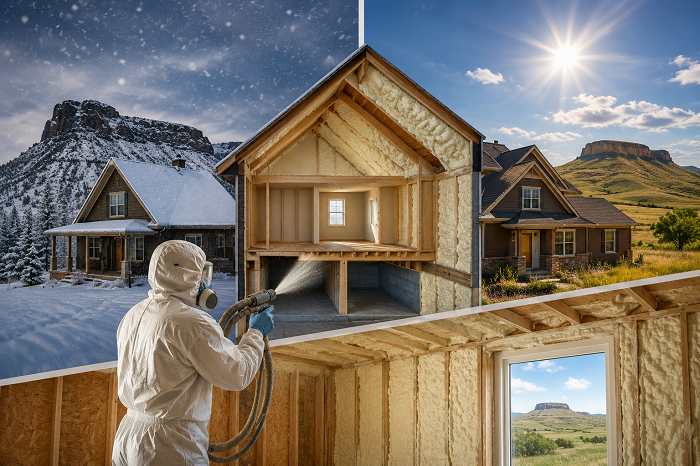
Living in South Dakota is not for the faint of heart. If you have spent even one winter here, you know that bone-chilling cold that seeps through walls like it owns the place. And then summer rolls around, and suddenly your house feels like a slow cooker. The weather here does not play nice, and your home’s insulation is the only thing standing between you and those brutal extremes.
Here is the honest truth that a lot of homeowners overlook: most traditional insulation systems were not built to handle the kind of punishment South Dakota dishes out. Fiberglass batts compress over time, lose their R-value, and leave behind gaps that act like open doors for cold air. Blown-in cellulose settles. And all the while, your heating and cooling bills quietly climb.
That is exactly why more and more homeowners across the state are turning to spray foam. It is not just a trend. It is a real, lasting solution for a climate that demands more from your building envelope than most insulation can deliver.
What Makes Spray Foam Different From Everything Else
Let me paint a picture. It is January in Rapid City, and the wind chill has dropped to minus 20. Your furnace is running almost constantly, but there are still cold spots near your windows and in the corners of your basement. You pile on another blanket and wonder why your energy bills look like a second mortgage.
That scenario is not just about your furnace. It is about air infiltration, and no insulation material addresses it better than spray foam.
When applied, spray foam expands to fill every crack, gap, and void in a wall cavity or attic space. It bonds directly to wood, concrete, metal, and masonry, creating a seamless thermal and air barrier in one application. There is no sagging, no settling, no gaps forming years down the road.
There are two main types, and each has its place depending on where and how it is being used.
Open-cell spray foam is softer, more flexible, and vapor-permeable. It is ideal for interior walls, sound dampening, and areas where some moisture movement is acceptable. It expands dramatically during application, which makes it great for filling irregular cavities.
Closed-cell spray foam is the heavyweight. It is denser, more rigid, and acts as both an air barrier and a vapor retarder. It delivers a higher R-value per inch than almost any other insulation material on the market. For South Dakota’s climate, closed-cell is often the go-to choice for exterior walls, crawl spaces, and below-grade applications.
Understanding which type belongs where is part science, part experience. Getting that wrong can lead to moisture problems, structural damage, or poor thermal performance.
How South Dakota’s Climate Shapes the Decision
South Dakota is classified as a mixed-dry to mixed-humid climate, depending on which part of the state you are in. The Black Hills see heavy snowfall and significant temperature swings. The eastern part of the state deals with high humidity in summer and brutal wind chills in winter. The central region can feel like a whole different world from one season to the next.
That variability means insulation cannot be a one-size-fits-all conversation.
In the western part of the state, closed-cell spray foam on exterior walls and rim joists can dramatically reduce heat loss during those extended cold snaps. In the east, where summer humidity becomes a real issue, a hybrid approach using open-cell foam in walls and closed-cell in the crawl space often makes the most sense.
The attic is a story unto itself. In summer, an uninsulated or poorly insulated attic can reach temperatures above 140 degrees Fahrenheit. That heat radiates downward into your living space and forces your air conditioner to work overtime. Spray foam applied directly to the underside of the roof deck creates what is called an unvented attic assembly. This keeps mechanical systems in the attic within the conditioned envelope of the home, dramatically improving their efficiency and lifespan.
These are not guesses or generalizations. They are the kinds of insights that come from years of working in this specific region, understanding how the climate behaves and what buildings actually need.
Why Professional Installation Matters for Spray Foam Insulation Solutions in South Dakota
This is where experience becomes everything.
Spray foam is not a DIY product, at least not if you want it done right. The chemicals involved require precise mixing ratios and temperature conditions during application. If the substrate is too cold or too warm, the foam will not cure properly. If the ratio is off, you end up with a tacky, under-cured mess that off-gasses for months and provides a fraction of the intended performance.
Spray foam contractors need to understand building science, not just how to pull a trigger on a proportioner. They need to know where thermal bridges form, how vapor drives work in different seasons, and how to properly detail around windows, doors, and penetrations.
That is the kind of knowledge that makes the difference between a job that saves you money for 30 years and one that creates moisture problems and callback headaches.
When homeowners in South Dakota are looking for Spray Foam Insulation Solutions in South Dakota, they deserve contractors who show up with the right equipment, the right training, and genuine accountability for their work.
The Real Cost Conversation
A lot of homeowners hesitate when they hear the upfront cost of spray foam compared to fiberglass. That hesitation makes sense. But it misses the bigger picture.
A well-installed spray foam system in a South Dakota home can reduce heating and cooling costs by 30 to 50 percent annually. In a state where winters can last five months and summers push air conditioners to their limits, that adds up fast. Over the course of 10 to 15 years, the energy savings alone typically exceed the initial investment, and the foam keeps performing for the life of the building.
There is also the comfort factor, which is harder to put a dollar on but very real. Eliminating drafts, stabilizing indoor temperatures, and reducing noise infiltration from outside changes how a home feels every single day. It is the difference between living in your house and truly enjoying it.
Beyond energy and comfort, spray foam can improve indoor air quality by reducing the infiltration of allergens, pollen, dust, and outdoor pollutants. For families with asthma or allergies, that benefit is not a small thing.
Where Spray Foam Makes the Biggest Difference in South Dakota Homes
Let’s get specific about the areas where Spray Foam Insulation Solutions in South Dakota deliver the most impact.
Rim joists and band joists are among the most significant sources of air infiltration in older homes. They sit at the intersection of the foundation and floor framing and are notoriously difficult to insulate with traditional materials. A few inches of closed-cell foam seals them completely.
Crawl spaces are another problem area, particularly in homes built on piers or over unheated spaces. An uninsulated or poorly insulated crawl space pulls cold air up through the floor and creates ideal conditions for mold and rot. Spray foam on the walls of an encapsulated crawl space transforms it from a liability into a clean, dry, conditioned space.
Attic hatch and knee wall areas are frequently overlooked but can account for a surprising amount of heat loss. Spray foam seals these transitions effectively in ways that cut-and-cobble rigid foam and batt combinations rarely achieve.
Pole barns, shops, and agricultural buildings also benefit enormously. South Dakota’s agricultural communities rely on spray foam to protect livestock, equipment, and stored materials from temperature extremes. A well-insulated shop is a more productive and comfortable workspace through every season.
Nespor Contracting Inc: Local Knowledge, Real Results
When it comes to finding a contractor who understands South Dakota conditions, proximity and experience matter more than most people realize.
Nespor Contracting Inc brings hands-on experience with the unique demands of this region. Their approach to Spray Foam Insulation Solutions in South Dakota is rooted in building science, not just square footage and product specs. They understand that every home has its own quirks, and the right insulation strategy accounts for the structure, the occupants, and the specific climate zone where the building sits.
Working with a contractor who knows South Dakota means getting recommendations that actually fit your situation, not just what happens to be in the truck. It means honest assessments of where your home is losing the most energy and thoughtful solutions that work within your budget without cutting corners on quality.
What to Ask Before You Hire Anyone
If you are serious about upgrading your insulation, here are a few questions worth asking any contractor before you sign anything.
Do they carry proper licensing and insurance? Spray foam involves chemicals and pressurized equipment. Liability coverage matters.
Can they explain the difference between open-cell and closed-cell foam and tell you specifically why they are recommending one over the other for your situation? If they cannot give you a clear answer, that is a red flag.
Do they do a pre-installation walk-through to identify moisture issues, existing air leaks, or structural concerns? Spray foam applied over a moisture problem does not fix the moisture problem. It hides it.
What does their warranty cover, and what are the terms?
Good contractors welcome these questions. They are signs of an informed homeowner, not a difficult one.
Conclusion: Insulation That Works as Hard as You Do
South Dakota asks a lot of the people and buildings within its borders. The winters are relentless, the summers are unforgiving, and the temperature swings in between can stress even well-built homes. Generic insulation solutions were not designed for conditions like these.
Spray foam, installed correctly by experienced professionals, changes the equation. It creates a building envelope that actually holds up against air infiltration, moisture movement, and the kind of thermal stress that traditional materials simply cannot handle season after season.
If you have been living with cold spots, high utility bills, or a home that never quite feels right no matter how you adjust the thermostat, the answer is not a newer furnace or a more efficient air conditioner. Nine times out of ten, it is the building envelope.
Getting informed is the first step, and getting the right team involved is the second. The right Spray Foam Insulation Solutions in South Dakota can transform your home into a space that is genuinely comfortable in every season, not just the mild weeks in May and September.
Your home deserves insulation that works as hard as you do. South Dakota does not take seasons off, and neither should your walls.