 (605) 840-1531
  sanespor@gwtc.net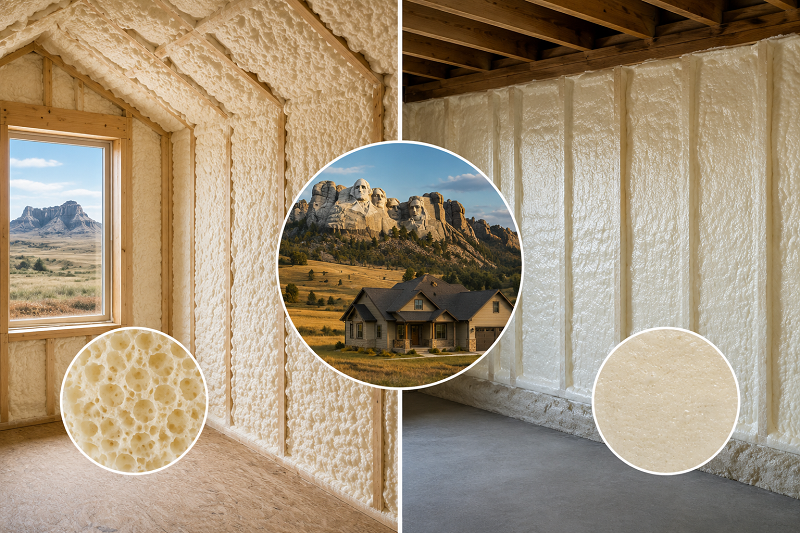
There is a particular kind of cold that South Dakota homeowners know well. It is not just the number on the thermometer — it is the draft that sneaks in around the window frame at 2 a.m., the heating bill that arrives in January and ruins your morning, or the ice dam that forms on the roof every single winter without fail. If you have lived here long enough, you stop being surprised by those things. You start looking for real solutions.
That is exactly what brings most people to the conversation about spray foam insulation in South Dakota. They are tired of patching problems. They want something that actually works, something built for this climate. And once they start researching, they quickly run into a choice that nobody warned them about: open-cell foam or closed-cell foam?
These two products look almost identical to the untrained eye. They are applied the same way, by a professional with a spray rig. But they perform very differently — and in a state where winters routinely push temperatures below zero and summers can swing hot and dry, making the right choice between them can mean the difference between real energy savings and a system that falls short.
This guide will walk you through exactly what separates the two, where each one belongs, what it costs, and how to think through your own home’s needs. No fluff. Just honest, practical information from people who understand what South Dakota buildings are actually up against.
What Spray Foam Actually Does (and Why It Is Different)
Before comparing the two types, it helps to understand why spray foam is in a different category than fiberglass batts or blown-in cellulose in the first place.
Traditional insulation slows the transfer of heat. Spray foam does that too, but it also seals air — completely. When the foam is sprayed into a wall cavity, roof deck, or basement wall, it expands and fills every gap, crack, and irregular surface. The result is an air barrier and insulation layer combined into one material. That combination is what makes it so effective in climates with extreme temperature swings.
Air leakage is responsible for as much as 40 percent of a home’s heating and cooling losses, according to building science research. Fiberglass does nothing to stop that leakage. Spray foam does. That distinction is why homeowners across the region are increasingly turning to spray foam insulation in South Dakota as their long-term solution, rather than a temporary fix.
Open-Cell Spray Foam: The Softer, More Flexible Option
Open-cell foam is sometimes described as the “softer” of the two types, which is an accurate description. Once cured, it has a spongy, almost cushion-like texture. The cells that make up the foam are intentionally left open, which gives it a lower density and a lower R-value per inch compared to its counterpart.
R-value: Approximately 3.5 to 4.0 per inch.
What it does well:
Open-cell foam is excellent at sealing air. Despite its lower density, it still expands aggressively to fill the cavities where it is applied. It is particularly good at sound dampening, which is a real benefit in homes near highways, in noisy neighborhoods, or in multi-story houses where noise transfer between floors is an issue.
It also breathes — meaning moisture vapor can pass through it. For some applications inside a home, this is actually desirable. When applied to interior walls or attic floors in conditioned spaces, open-cell foam allows the building to manage moisture naturally without trapping it.
Where it makes sense:
Open-cell foam is typically well-suited for interior walls, attic floors (not roof decks), and areas inside the building envelope where moisture vapor barriers are handled separately. It is also a popular choice for homeowners who want the performance of spray foam at a lower cost per square foot.
Where it falls short:
This is where South Dakota’s climate demands some honest thinking. Open-cell foam should not be used in below-grade applications like basements or crawl spaces, because it can absorb moisture over time. It also does not provide the vapor barrier that is critical in cold climates. In a state where outdoor humidity and indoor moisture gradients are significant — especially in winter — placing open-cell foam in the wrong location can lead to condensation and moisture problems rather than preventing them.
Closed-Cell Spray Foam: The Workhorse for South Dakota’s Climate
If you ask most contractors what they recommend for the majority of residential applications in this part of the country, closed-cell foam tends to come up first. There are good reasons for that, and they are not just marketing.
Closed-cell foam is dense. Its cells are fully enclosed and tightly packed, which creates a rigid, hard structure once it cures. That density is what gives it properties that open-cell foam simply cannot match.
R-value: Approximately 6.0 to 7.0 per inch — roughly double that of open-cell.
What it does well:
Closed-cell foam acts as both an insulator and a vapor barrier simultaneously. In South Dakota’s cold winters, the temperature differential between inside and outside creates significant vapor drive — warm, moist interior air wants to push toward the cold exterior. Without a vapor barrier, that moisture migrates into the wall assembly and can lead to mold, rot, and structural damage over time. Closed-cell foam stops that process cold.
It also adds structural strength. When applied to walls and roof decks, closed-cell foam bonds to the framing and sheathing, increasing racking resistance. Some studies have shown that spray foam can improve a wall’s structural performance by two to three times compared to standard framing with fiberglass insulation. In a region where wind loads during blizzards and spring storms can be significant, that is not a trivial benefit.
Additionally, closed-cell foam is completely water-resistant. It will not absorb water if a basement takes on moisture, and it will not deteriorate when exposed to humidity. That makes it the right choice for crawl spaces, basement walls, and any below-grade application.
Where it belongs:
Basements, crawl spaces, exterior walls, roof decks, pole barns, metal buildings, and any location where both insulation performance and moisture control are required. Companies like Nespor Contracting Inc specialize in helping homeowners identify exactly where closed-cell foam will deliver the greatest long-term return on their investment.
The Cost Reality: What to Expect
No conversation about insulation is complete without addressing cost, because it is often the deciding factor for homeowners who are otherwise sold on the benefits.
Open-cell spray foam generally runs between $0.45 and $0.75 per board foot for materials. Installed, you are typically looking at $1.00 to $1.50 per square foot for thinner applications, with final project costs depending heavily on depth, square footage, and accessibility.
Closed-cell foam costs more — usually $1.00 to $1.75 per board foot, with installed costs ranging from $2.00 to $4.00 per square foot or higher depending on thickness. For a full basement or roof deck project, that difference adds up quickly.
But here is the context that matters: closed-cell foam delivers a higher R-value per inch, meaning you need less material to hit the same performance target. It also eliminates the need for a separate vapor barrier in many applications, which reduces overall project cost. And because it outperforms other insulation types so significantly, most South Dakota homeowners see their investment returned through energy savings within a few years.
For budget-conscious homeowners, a hybrid approach is increasingly common — closed-cell foam in the most critical areas (basement walls, rim joists, exterior-facing cavities) and open-cell foam in interior applications where the vapor barrier function is not needed. This approach allows you to optimize performance without overspending.
How South Dakota’s Climate Shapes the Decision
It bears repeating, because it genuinely matters: South Dakota is not a mild climate. Sioux Falls, Rapid City, Aberdeen, and virtually every community in the state will see temperatures below zero multiple times each winter. The vapor drive in these conditions is intense. Wind chill factors routinely push the “feels like” temperature down dramatically.
In climates like this, building science guidelines generally favor closed-cell foam for any exterior or below-grade application. Open-cell foam without an additional vapor barrier simply does not perform at the level this climate demands for those locations.
This is one of the main reasons experienced insulation contractors in the state lean toward closed-cell foam as their default recommendation for exterior walls, roof assemblies, and anything below grade. The extra cost upfront is almost always justified by long-term performance, moisture protection, and energy savings.
What to Ask Your Contractor Before Work Begins
Getting the right product installed in the right place requires more than just picking a foam type. Before any work begins, here are the questions worth asking:
What climate zone does South Dakota fall under, and how does that affect R-value requirements? South Dakota is primarily in Climate Zones 5 and 6, which have specific minimum insulation requirements under building codes.
Do I need a vapor barrier on top of or in addition to the foam? In some applications, even closed-cell foam may require supplemental vapor control depending on wall assembly design.
Is my attic vented or unvented? The answer significantly changes whether open-cell or closed-cell foam belongs on the roof deck versus the attic floor.
What is the long-term maintenance picture? Properly installed spray foam requires virtually no maintenance and lasts the life of the building — but improper installation can cause problems that are expensive to fix.
Working with a knowledgeable local contractor like Nespor Contracting Inc ensures these questions get answered before the spray rig ever shows up, not after problems emerge down the road.
The Bottom Line
Choosing between open-cell and closed-cell spray foam is not about which one is “better” in an absolute sense. Both products do their jobs well when used correctly. The real question is where in your home each product belongs, and what your climate demands.
For most South Dakota homeowners, closed-cell foam is the right choice for exterior walls, basements, crawl spaces, and roof decks — anywhere moisture control and maximum thermal performance are non-negotiable. Open-cell foam earns its place in interior applications, attic floors, and situations where budget is a primary constraint and vapor control is handled separately.
Spray foam insulation in South Dakota is not a luxury upgrade. It is a practical, long-term investment in a home that needs to perform through conditions that would punish inferior insulation year after year. Done right, it reduces energy bills, prevents moisture damage, improves indoor air quality, and makes a home genuinely more comfortable in every season.
If you are ready to stop fighting your heating system every winter and start actually solving the problem, the best first step is a conversation with a qualified local contractor who knows this climate and knows these products. The right foam, in the right place, installed by the right hands — that is where real results come from.