 (605) 840-1531
  sanespor@gwtc.net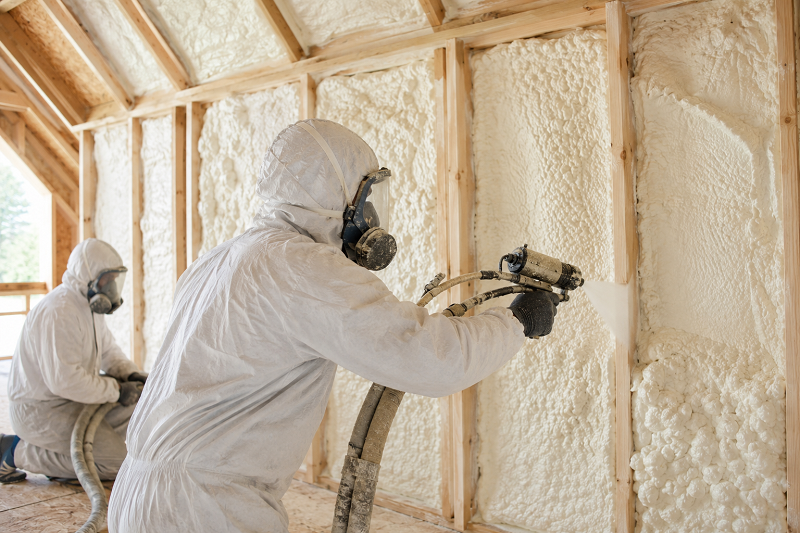
South Dakota isn’t a forgiving place when it comes to weather. Depending on where you live in the state, you might deal with bitter sub-zero January nights, ice storms that sneak up on you, summer humidity that creeps into your crawl space, and wind that finds every tiny gap in your walls like it has something to prove. Choosing the wrong insulation in a climate like this isn’t just an inconvenience. It can cost you hundreds of dollars every single winter, and the moisture problems that follow can cause damage that’s not cheap to fix.
Spray foam insulation has become the go-to solution for many homeowners and contractors across the state, and for good reason. But not all spray foam is the same. Open cell and closed cell foam behave very differently, cost different amounts, and suit different situations. Understanding these differences, especially in the context of South Dakota’s climate zones, is the key to making a smart, long-lasting decision.
The Physical Difference: It’s All in the Cells
To understand why these two foams perform so differently, you have to start with what’s actually happening at a microscopic level. Both are made from polyurethane, but they’re structured completely differently once they expand and cure.
With open cell foam, the tiny bubbles that form during curing remain unsealed. Air fills those open pockets, which gives the foam a soft, spongy feel and a surprisingly good ability to expand into tight corners. It’s flexible and lightweight, and it breathes a little. That sounds appealing until you realize that in South Dakota’s climate, “breathes a little” can mean “lets moisture in.”
Closed cell foam, on the other hand, forms cells that are fully sealed and packed tightly together. The result is a dense, rigid material with no open pathways for air or moisture. When contractors talk about hard closed cell foam in South Dakota, this is exactly what they mean: a firm, boardlike foam that bonds to surfaces and creates a genuine barrier against the elements. It doesn’t flex. It holds its shape. And for a state with serious temperature swings, that rigidity is a feature, not a drawback.
Hard Closed Cell Foam
- R-value per inchR-6 to R-7
- Density1.75 to 2.2 lb/ft³
- Moisture barrierYes (vapor barrier)
- Structural supportYes
- Cost per sq ft$1.00 to $4.00
- Best climateCold, extreme zones
Open Cell Foam
- R-value per inchR-3.6 to R-3.9
- Density~0.5 lb/ft³
- Moisture barrierNo (vapor-permeable)
- Structural supportMinimal
- Cost per sq ft$0.50 to $2.00
- Best climateMild, southern regions
R-Value: Why It Matters More Here Than Almost Anywhere Else
R-value measures thermal resistance. The higher the number, the better the insulation resists heat transfer. In a state like South Carolina or Texas, you might have a temperature difference between indoors and outdoors of around 30 to 40 degrees Fahrenheit during the coldest part of winter. In South Dakota, that delta regularly hits 70 degrees or more. Your walls are working far harder here than they would anywhere in the South.
R-7Closed cell foam per inch of thickness
R-3.8Open cell foam per inch of thickness
70°F+Typical indoor-outdoor temp delta in SD winters
That near 2x difference in R-value per inch is significant when wall cavity space is limited. If you have a standard 2×4 stud wall with about 3.5 inches of usable cavity space, closed cell foam can deliver roughly R-21 to R-24 within that space. Open cell in the same cavity gives you around R-13. That’s a meaningful gap when your heating system is already running overtime between November and March.
South Dakota climate note: Many insulation experts use the southern border of Pennsylvania as a rough guideline. North of that line, and especially in the Northern Plains, closed cell foam is strongly preferred because extreme cold demands maximum thermal resistance and a reliable vapor barrier. South Dakota sits squarely in that territory.
Moisture: The Silent Enemy of South Dakota Homes
Here’s something a lot of homeowners don’t think about until it’s too late. Moisture in insulation isn’t just an efficiency problem. It’s a mold problem, a rot problem, and eventually a structural problem. In South Dakota basements and crawl spaces, where ground moisture can creep in consistently, and in metal agricultural buildings where condensation is a daily reality, your insulation’s relationship with water matters enormously.
Open cell foam absorbs moisture. It’s vapor-permeable by nature, which means warm, moist interior air can pass through it and reach your wall sheathing or roof deck. When that moisture meets a cold surface in winter, it condenses. Over time, that creates exactly the conditions mold and rot need to thrive. In mild climates, this can be managed with a separate vapor barrier. In South Dakota winters, it’s a much bigger risk.
Closed cell foam acts as its own vapor barrier. At 2 inches of thickness, it effectively blocks moisture movement through the assembly. This is why hard closed cell foam in South Dakota is so widely used in basements, crawl spaces, pole barns, and metal buildings throughout the state. Contractors who’ve been doing this work for years will tell you that for anything below grade, closed cell isn’t just preferred. It’s basically the only responsible choice.
When a South Dakota winter is driving moisture hard against your walls, you want insulation that doesn’t negotiate with water. Closed cell foam doesn’t. That rigidity, that density, is exactly what makes it so effective in this part of the country.
Structural Strength: A Benefit Most People Don’t Expect
One thing that surprises homeowners who are new to closed cell foam is that it actually adds measurable rigidity to walls, roofs, and floors. Because it cures into a hard, board-like material and bonds firmly to the surfaces it touches, it can meaningfully strengthen a wall assembly. For pole barns, metal buildings, and older homes that might have a little flex in the framing, this is a real practical benefit.
Open cell foam offers none of this. Its soft, spongy structure simply fills a cavity. It doesn’t bond to framing with anything like the same force, and it contributes no structural value to the assembly. For a typical interior partition wall in a newer home, that might not matter much. But for agricultural buildings and outbuildings where structural durability is important, closed cell wins clearly.
Where Each Type of Foam Actually Belongs
Best applications for closed cell foam
- Basements and crawl spaces (moisture resistance is critical here)
- Pole barns, metal buildings, and agricultural structures
- Exterior walls in all SD climate zones, especially west of the Missouri River
- Roof decks and cathedral ceilings where high R-value in limited space matters
- Rim joists and band joists, where cold bridging is common
- Any application that needs a built-in vapor barrier
Applications where open cell foam can work
- Interior partition walls where soundproofing is the main goal
- Attic ceiling cavities in conditioned attic assemblies where drying potential exists
- Spaces where upfront cost is a primary constraint and moisture risk is low
- Large irregular wall cavities in interior spaces where generous expansion helps fill gaps
The Cost Question: Cheap Now vs. Expensive Later
Let’s be real. Open cell foam costs less upfront. Typically somewhere between $0.50 and $2.00 per square foot compared to $1.00 to $4.00 for closed cell. For a large home or commercial project, that difference can feel significant when you’re reviewing quotes.
But cost per square foot isn’t the right way to evaluate insulation in a northern climate. You also need to factor in the cost of energy lost through lower R-value performance over the 20 or 30 year life of the insulation. You need to factor in the potential cost of moisture-related repairs if vapor control is inadequate. And you need to factor in whether you’ll need a separate vapor barrier installed alongside the open cell foam to meet building codes, which adds both labor and materials cost.
Most experienced South Dakota contractors will tell you that over a 10-year window, the energy savings from hard closed cell foam in South Dakota more than offset its higher initial installation cost. It’s a rare case where paying more upfront genuinely saves money in the long run.
So which one does your South Dakota home actually need?
If your project involves a basement, crawl space, exterior wall, pole barn, roof deck, or any space that needs a vapor barrier, the answer is closed cell foam. The South Dakota climate is unforgiving, and this foam was built for exactly that kind of pressure.
Open cell foam has a role, but it’s a limited one in this state. Think interior soundproofing in conditioned spaces. For anything that touches the building envelope, especially in a state with 50-plus days of below-freezing temperatures, closed cell is the professional standard for good reason.
A Few Things to Ask Your Contractor Before Committing
Not all spray foam installers have the same level of training or equipment quality. Because closed cell foam requires precise chemical mixing ratios and consistent application lift thickness to cure correctly, the skill of the installer matters as much as the product itself. Before signing anything, it’s worth asking a few direct questions.
Ask whether they use 2lb closed cell for interior applications and 3lb for roofing applications, since those are the industry-standard densities for each use case. Ask how they handle prep and cleanup, and whether they trim back excess foam for clean substrate contact. Ask about their equipment maintenance routine, because off-ratio foam caused by poorly calibrated equipment can degrade performance significantly. A good contractor won’t flinch at any of these questions. They’ll be glad you asked.
Final Thoughts: Insulation That Earns Its Keep
Choosing insulation isn’t the most exciting part of owning or building a home. But in a state where your heating system runs for the better part of six months a year, it might be one of the most financially consequential decisions you make about your building envelope.
Open cell foam has its uses. It’s affordable, flexible, and effective in the right interior applications. But for the majority of South Dakota homes dealing with real winters, real moisture, and real structural demands, closed cell foam is simply the more appropriate choice. Its higher R-value per inch, built-in moisture resistance, and structural contribution make it the insulation that actually performs when the temperature drops and the wind starts moving.
Talk to a certified local insulation contractor who understands the climate zone you’re building in. Whether you’re in the Black Hills, the James River Valley, or the eastern edge of the state near the Minnesota border, the specifics of your site and your structure will shape the final recommendation. But if you walk into that conversation already knowing the difference between these two foam types and why it matters here, you’ll make a far better decision for your home and your wallet.