 (605) 840-1531
  sanespor@gwtc.net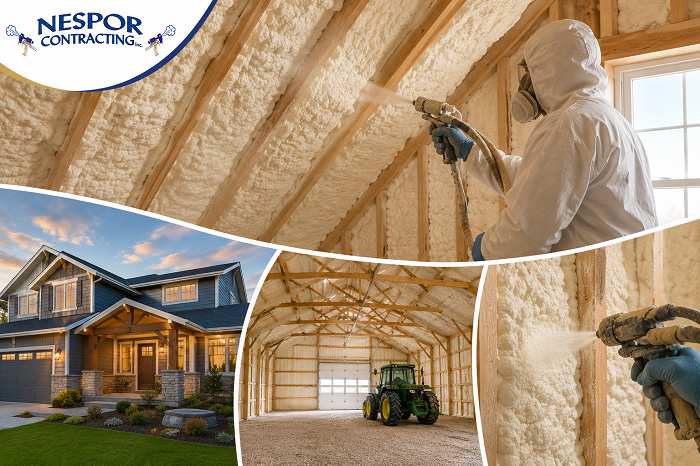
South Dakota is not a state that goes easy on its buildings. One week you’re dealing with a blizzard piling snow against your foundation, and the next a summer heat wave is baking your attic until it feels like a kiln. If you’ve been losing money on energy bills, or if you’ve noticed cold drafts sneaking in through walls you thought were sealed, the problem usually isn’t your furnace or your air conditioner. More often than not, it’s your insulation.
Property owners across the state are making a shift, moving away from old-school fiberglass batts and blown-in cellulose toward something that actually holds up to what South Dakota throws at it. Spray Foam Insulation in SD has become the go-to solution for homeowners, farmers, and commercial property owners who want real, lasting results, not just a temporary fix.
At Nespor Contracting Inc, we’ve seen firsthand how much of a difference the right insulation makes, especially when the temperatures swing forty degrees in a single day. This post is written to give you an honest, thorough look at why this material has earned its reputation and why so many property owners in this region are choosing it.
Why South Dakota’s Climate Demands More From Your Insulation
Before getting into the specifics of spray foam, it helps to understand what your insulation is actually up against here.
South Dakota sits in a climate zone that the U.S. Department of Energy classifies as zones 5 and 6 in most areas, meaning winters are genuinely harsh and summers aren’t mild either. Rapid City can see temperatures below zero Fahrenheit in January and above 100°F in July. The Black Hills region adds elevation and wind chill to the mix. The eastern part of the state faces humidity fluctuations and powerful storms rolling in from the plains.
What this means practically is that your insulation has to perform in both extremes, and it has to do it while resisting moisture, preventing air infiltration, and maintaining its effectiveness year after year. Traditional insulation products often fall short on one or more of these fronts. Fiberglass batts, for instance, lose a significant portion of their rated R-value when air passes through them, which happens constantly in a drafty wall assembly.
Spray foam doesn’t have that problem.
What Makes Spray Foam Different: The Science Behind It
Spray polyurethane foam works by expanding on contact with the surface it’s applied to, filling every crack, gap, and irregular void in the building envelope. When it cures, it creates a continuous, rigid (or semi-rigid, depending on the type) barrier that stops both heat transfer and air movement at the same time.
There are two main types:
Open-cell spray foam is lighter, more flexible, and more affordable. It’s excellent for interior walls and sound dampening. It has a lower R-value per inch but expands aggressively to fill large cavities.
Closed-cell spray foam is the heavy-duty option. It achieves R-values between 6 and 7 per inch, making it the highest-performing insulation product available by thickness. It also acts as a vapor barrier, which matters enormously in a climate like South Dakota’s where moisture can migrate through walls and condense inside your structure.
Spray Foam Insulation in SD is particularly valuable because of that air sealing function. The EPA has noted that air leakage can account for up to 40% of a home’s heating and cooling losses. Spray foam addresses that directly.
The Real-World Benefits South Dakota Property Owners Are Experiencing
Dramatic Reductions in Heating and Cooling Costs
This is usually the first thing people notice after a spray foam installation. When your building envelope is properly sealed and insulated, your HVAC system doesn’t have to work as hard. Many property owners report energy bill reductions of 30% to 50% compared to their pre-installation costs.
Given how long South Dakota winters can stretch on, those monthly savings add up quickly. Over a ten-year period, the energy savings from a quality spray foam installation can exceed the upfront cost of the project many times over.
Protection Against Moisture and Mold
Closed-cell spray foam doesn’t absorb moisture. It won’t sag, compress, or lose its shape when exposed to humidity or occasional condensation. In older South Dakota farm buildings or basements that see seasonal moisture intrusion, this is a critical advantage.
When fiberglass batts get wet, they become nearly useless as insulation and become a breeding ground for mold. Spray foam eliminates that vulnerability.
Structural Reinforcement
This one surprises a lot of people. Closed-cell spray foam actually adds rigidity to the structures it’s applied to. When sprayed into wall cavities or along rooflines, it bonds to the substrate and increases the racking strength of walls. For buildings in areas prone to high winds, including much of western South Dakota, this is a meaningful benefit.
Year-Round Comfort, Not Just Lower Bills
Beyond the numbers on an energy bill, spray foam changes how a building feels. Rooms that used to be cold in winter or stuffy in summer start to maintain consistent temperatures. That cold floor in your mudroom, the drafty corner of your living room, the attic that your HVAC can never seem to tame — these issues typically disappear after a proper installation.
Long Service Life
Unlike fiberglass that can settle and lose effectiveness over decades, properly installed spray foam maintains its performance essentially indefinitely. It doesn’t shift, it doesn’t compress, and it doesn’t attract pests the way cellulose can. Once it’s in, you’re set.
Agricultural and Commercial Applications in South Dakota
The benefits of Spray Foam Insulation in SD extend well beyond residential homes. South Dakota has a massive agricultural economy, and the structures that support it, machine sheds, grain storage buildings, livestock barns, and equipment shops, all benefit enormously from spray foam.
Metal buildings in particular are notoriously difficult to insulate with traditional materials. Condensation on cold steel is a constant problem that damages equipment, promotes rust, and creates uncomfortable working conditions. Spray foam applied directly to the interior of metal panels solves the condensation problem completely while also adding insulation value and noise reduction.
Commercial properties like warehouses, retail spaces, and offices see similar benefits. Lower operating costs, better interior comfort for employees and customers, and reduced HVAC maintenance loads all contribute to a stronger bottom line.
Nespor Contracting Inc has worked on a wide range of these projects across the region, and the consistent feedback is the same regardless of the building type: the results speak for themselves.
What to Expect From a Professional Installation
A quality spray foam job isn’t a DIY project. The materials require professional-grade equipment and proper training to apply safely and effectively. Temperature, humidity, mixing ratios, and application thickness all need to be managed carefully to ensure the foam cures correctly and achieves its rated performance.
A reputable contractor will:
- Assess your existing building envelope and identify problem areas
- Recommend the right type of foam (open-cell or closed-cell) for each application
- Prepare the space properly, ensuring surfaces are clean and dry
- Apply the foam in controlled lifts to avoid heat buildup during the exothermic curing process
- Inspect the finished product to confirm coverage and thickness
Spray Foam Insulation in SD done right is an investment that pays dividends for the life of your building. Done poorly, it can result in incomplete coverage, off-ratio foam that doesn’t perform, or even chemical off-gassing issues during curing. Choosing an experienced, licensed contractor isn’t just a preference; it’s essential.
Frequently Asked Questions
Q: Is spray foam worth the higher upfront cost compared to fiberglass? A: For most South Dakota properties, yes. The energy savings typically offset the cost difference within three to seven years, and the performance advantage lasts for decades. When you factor in moisture protection, air sealing, and structural benefits, the value proposition is strong.
Q: Can spray foam be added to an existing home, or is it only for new construction? A: Spray foam can be applied in existing homes through various methods, including open-wall application during a renovation, crawl space and basement applications, and attic installation. A professional assessment will identify the best approach for your specific structure.
Q: Does spray foam really prevent moisture problems in South Dakota’s climate? A: Closed-cell spray foam acts as both an insulator and a Class II vapor retarder. It significantly reduces the moisture drive through walls and prevents the condensation issues that cause mold and structural damage in traditionally insulated buildings. For South Dakota’s climate fluctuations, this is one of its most important qualities.
Q: How long does a spray foam installation take? A: Most residential projects are completed in one to two days. Larger agricultural or commercial projects may take longer. The foam reaches its full cure within 24 hours, though the building can typically be reoccupied much sooner.
Q: Will spray foam help with noise as well as temperature? A: Open-cell spray foam in particular has excellent sound dampening properties. Many homeowners and business owners notice a meaningful reduction in exterior noise and sound transfer between rooms after installation.
Q: Is spray foam environmentally responsible? A: Modern spray foam formulations have evolved significantly in terms of their environmental profile. Many products now use blowing agents with low global warming potential. Additionally, the dramatic reduction in energy consumption over the life of the building represents a significant environmental benefit.
Making the Right Call for Your Property
Every property is different, and the right insulation strategy depends on your building’s age, construction type, existing insulation, and your goals. But for most South Dakota property owners dealing with the real challenges of this climate, the case for spray foam is compelling.
The combination of superior air sealing, high R-value per inch, moisture resistance, and long service life makes it uniquely suited to what properties here have to endure. When you factor in the energy savings, the improved comfort, and the protection it provides to the structure itself, it becomes less of an expense and more of a smart investment in the longevity of your property.
If you’ve been on the fence, the best next step is a professional consultation. The team at Nespor Contracting Inc brings deep experience working with South Dakota properties of all types, and they can give you an honest assessment of what spray foam could do for your specific building.
The winters aren’t getting shorter. The energy costs aren’t going down. And your building deserves insulation that actually works as hard as you do.